Cerebras Unveils Six Data Centers to Meet Accelerating Demand for AI Inference at Scale
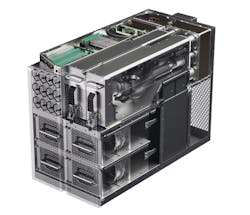
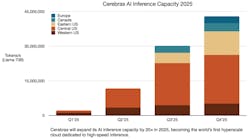
Putting a stake in the ground to define its role in artificial intelligence, AI accelerator developer Cerebras announced they would be adding six new data centers to their global AI inference network, expanding capacity 20X to create the leading domestic high-speed inference cloud with 85% of the capacity in the United States.
The inference cloud network will be able to serve over 40 million Llama 70B tokens per second.
Inference networks are typically used in real-time AI applications, where pre-trained models make predictions, classify data, detect patterns, or generate outputs based on input data.
This is different from typically discussed AI training: the inference network makes use of the trained AI model provided to serve the real-time needs of the customer.
Cerebras AI Inference Data Centers:
- Santa Clara, CA (online)
- Stockton, CA (online)
- Dallas, TX (online)
- Minneapolis, MN (Q2 2025)
- Oklahoma City, OK (Q3 2025)
- Montreal, Canada (Q3 2025)
- Atlanta, GA (Q4 2025)
- France (Q4 2025)
Six of the data centers will be operated by Cerebras partner G42, who in 2023 worked with Cerbras to launch the Condor Galaxy AI supercomputer, with an AI training capacity of 36 exaFlops.
The AI hardware in the separately owned Oklahoma City and Montreal datacenters (more on this below) is hardware owned and operated by Cerebras.
According to Dhiraj Mallick, COO, Cerebras Systems:
Cerebras is turbocharging the future of U.S. AI leadership with unmatched performance, scale and efficiency – these new global datacenters will serve as the backbone for the next wave of AI innovation. With six new facilities coming online, we will add the needed capacity to keep up with the enormous demand for Cerebras industry-leading AI inference capabilities, ensuring worldwide access to sovereign, high-performance AI infrastructure that will fuel critical research and business transformation.
The Cerebras CS-3 System: A Powerful AI Accelerator
These data centers will be deploying the Cerebras CS-3 Wafer Scale Engine -based AI accelerator. The Wafer Scale Engine is a unique and powerful AI accelerator developed by Cerebras Systems. Unlike traditional AI chips, which are typically built as smaller individual silicon dies, the WSE is a single, massive chip covering almost an entire silicon wafer. This wafer-scale integration makes it the largest chip ever built and offers significant computational capabilities.
Each WSE has 850,000 AI optimized cores that have been specifically designed for deep learning workloads. There is 40 GB of SRAM directly on the chip, rather than depending on external memory, and the chip boasts 20 petabytes per second of memory bandwidth, allowing for extremely fast data movement. AI models are processed on the single, huge wafer, which simplifies software and hardware management when compared to massive, interconnected networks of AI GPUs.
Taking On the AI Hyperscalers
Referencing popular reasoning models such as OpenAI o3 and DeepSeek R1, Cerbras highlights the fact that using these models can take minutes to generate an answer, but that Cerbras makes a fundamental business change by speeding up response time tenfold. Perplexity, the AI search engine that has been giving Google a run for its money, currently uses Cerebras technology to provide its instant search results.
While Cerebras has stated that the final location of the data centers may be subject to change, at least two of the data center locations, and their launch dates, were specifically identified the announcement. June 2025 will see more than 300 Cerebras CS-3 systems come online in Scale Data Center in Oklahoma City. Cerebras will be taking advantage of the Tier 3+ data center and its custom water-cooled solution with the company believes makes “uniquely suited” for the deployment of the WSE-based servers.
Trevor Francis, CEO of Scale Datacenter, said:
We are excited to partner with Cerebras to bring world-class AI infrastructure to Oklahoma City. Our collaboration with Cerebras underscores our commitment to empowering innovation in AI, and we look forward to supporting the next generation of AI-driven applications.
Meanwhile, in July of this year, Cerebras expects their Montreal data center, run by Enovum, to be fully operational. This will be the first deployment of the WSE at scale in the Canadian tech business world. According to Billy Krassakopoulos, CEO of Enovum Datacenter:
Enovum is thrilled to partner with Cerebras, a company at the forefront of AI innovation, and to further expand and propel Canada’s world-class tech ecosystem. This agreement enables our companies to deliver sophisticated, high-performance colocation solutions tailored for next-generation AI workloads.
Cerebras expects to be offering hyperscale-level services to their customers by Q3 of 2025.
6 Key Adjacent Data Center Industry Developments in Light of Cerebras’s New AI Acceleration Data Center Expansion
Cerebras Systems’ announcement of six new U.S. data center sites dedicated to AI acceleration has sent ripples across the data center and AI industries. As the demand for AI compute capacity continues to surge, this move underscores the growing importance of specialized infrastructure to support next-generation workloads.
Here are six important adjacent and competitive developments in the data center industry that are shaping the landscape in light of Cerebras’s expansion.
1. Hyperscalers Doubling Down on AI-Optimized Data Centers
Major cloud providers like Google, AWS, and Microsoft Azure are rapidly expanding their AI-optimized data center footprints. These hyperscalers are investing heavily in GPU- and TPU-rich facilities to support generative AI, large language models (LLMs), and machine learning workloads. Cerebras’s move highlights the competitive pressure on hyperscalers to deliver low-latency, high-performance AI infrastructure.
2. Specialized AI Hardware Ecosystems Gaining Traction
Cerebras’s Wafer-Scale Engine (WSE) technology is part of a broader trend toward specialized AI hardware. Competitors like NVIDIA (with its Grace Hopper Superchips and DGX systems) and AMD (with its Instinct MI300 series) are also pushing the envelope in AI acceleration. This arms race is driving demand for data centers designed to accommodate these unique architectures, including advanced cooling and power delivery systems.
3. Liquid Cooling Adoption Accelerates
The power density of AI workloads is forcing data center operators to rethink cooling strategies. Cerebras’s systems, known for their high compute density, will likely require liquid cooling solutions. This aligns with industry-wide adoption of liquid cooling technologies by companies like Equinix, Digital Realty, and EdgeConneX to support AI and HPC workloads efficiently.
4. Regional Data Center Expansion for AI Workloads
Cerebras’s choice to establish six new U.S. sites reflects a growing trend toward regional data center expansion to meet AI compute demands. Companies like CyrusOne, QTS, and Vantage Data Centers are also strategically building facilities in secondary markets to support AI and edge computing, ensuring low-latency access for enterprises and researchers.
5. Energy and Sustainability Challenges Intensify
The power requirements of AI-optimized data centers are staggering, with facilities often consuming 20-50MW or more. Cerebras’s expansion highlights the need for sustainable energy solutions, including renewable power procurement and advanced energy management systems. Competitors like Switch and Iron Mountain are leading the charge in building carbon-neutral data centers to address these challenges.
6. Partnerships Between AI Hardware and Data Center Providers
Cerebras’s announcement may signal deeper collaborations between AI hardware innovators and data center operators. Similar partnerships, such as NVIDIA’s work with CoreWeave and Lambda Labs, are becoming increasingly common as the industry seeks to integrate cutting-edge AI technologies into scalable, operational environments. Expect more joint ventures and alliances to emerge as AI infrastructure demands grow.
Conclusion
Cerebras’s expansion into six new U.S. data center sites for AI acceleration is a significant milestone that reflects the broader transformation of the data center industry. As AI workloads dominate the demand for compute, the industry is responding with specialized hardware, innovative cooling solutions, and strategic regional expansions. These developments underscore the critical role of data centers in enabling the next wave of AI innovation, while also highlighting the challenges of power, sustainability, and competition in this rapidly evolving space.
At Data Center Frontier, we talk the industry talk and walk the industry walk. In that spirit, DCF Staff members may occasionally enhance content with AI tools such as deepseek.
Keep pace with the fast-moving world of data centers and cloud computing by connecting with Data Center Frontier on LinkedIn, following us on X/Twitter and Facebook, as well as on BlueSky, and signing up for our weekly newsletters using the form below.
About the Author
 David Chernicoff
David Chernicoff
 Matt Vincent
Matt Vincent
Matt Vincent is Editor in Chief of Data Center Frontier, where he leads editorial strategy and coverage focused on the infrastructure powering cloud computing, artificial intelligence, and the digital economy. A veteran B2B technology journalist with more than two decades of experience, Vincent specializes in the intersection of data centers, power, cooling, and emerging AI-era infrastructure. Since assuming the EIC role in 2023, he has helped guide Data Center Frontier’s coverage of the industry’s transition into the gigawatt-scale AI era, with a focus on hyperscale development, behind-the-meter power strategies, liquid cooling architectures, and the evolving energy demands of high-density compute, while working closely with the Digital Infrastructure Group at Endeavor Business Media to expand the brand’s analytical and multimedia footprint. Vincent also hosts The Data Center Frontier Show podcast, where he interviews industry leaders across hyperscale, colocation, utilities, and the data center supply chain to examine the technologies and business models reshaping digital infrastructure. Since its inception he serves as Head of Content for the Data Center Frontier Trends Summit. Before becoming Editor in Chief, he served in multiple senior editorial roles across Endeavor Business Media’s digital infrastructure portfolio, with coverage spanning data centers and hyperscale infrastructure, structured cabling and networking, telecom and datacom, IP physical security, and wireless and Pro AV markets. He began his career in 2005 within PennWell’s Advanced Technology Division and later held senior editorial positions supporting brands such as Cabling Installation & Maintenance, Lightwave Online, Broadband Technology Report, and Smart Buildings Technology. Vincent is a frequent moderator, interviewer, and keynote speaker at industry events including the HPC Forum, where he delivers forward-looking analysis on how AI and high-performance computing are reshaping digital infrastructure. He graduated with honors from Indiana University Bloomington with a B.A. in English Literature and Creative Writing and lives in southern New Hampshire with his family, remaining an active musician in his spare time.
DCF Staff
Voices of the Industry
 Image courtesy of Midea Building Technologies
 Adobe Stock image courtesy of Hitachi Energy