Executive Roundtable: Tier Status of Popular U.S. Data Center Markets
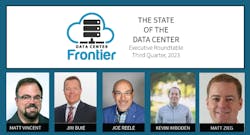
At DCF, we always like to ask the experts - in this case, the four seasoned industry leaders featured in our Executive Roundtable for the Third Quarter of 2023. We begin today with our experts' takes on the tier status of popular data center markets and locations in the U.S., besides the mainstays of Northern Virginia and Silicon Valley.
With all due respect toward the industry's perennial top two aforementioned markets, there are now numerous national hotspots for U.S. data center construction, deployment, and profitable, sustainable market activities. In our first round of executive inquiry, we seek to conduct a "temperature check" among our distinguished panelists, regarding the most desirable second and third tier markets and cities for data centers in 2023, and their relative merits.
In addition to today's discussion, throughout the week our panel of executive thought leaders will offer their observations on other pertinent industry topics, including:
- Forecasts for data center AI demands in the inflection point year of 2023, as created by the sudden rise of ChatGPT and similar large language models working hand in hand with GPU/TPU systems from technology front-runners Nvidia and Google.
- A general outlook in counseling harmonious data center investor and provider relations in 2023.
Here's an introduction to our distinguished panel:
- Jim Buie, President and CEO, Involta
- Joe Reele, VP Solutions Architects for Schneider Electric
- Kevin Imboden, Global Director of Market Research and Competitive Intelligence for EdgeConneX
- Matt Zieg, VP of Global Strategic Accounts for Vertiv
Over the course of this week, we’ll moderate a Q&A with these executives on each one of the three roundtable topics. We begin today with our Executive Roundtable's takes on popular secondary and tertiary data center markets and locations in the U.S.
Data Center Frontier: As data center builds and leasing in locations such as No. Va. And Silicon Valley remain increasingly challenged, the prognosis for industry growth in 2nd and 3rd tier U.S. data center markets continues to improve. What are your top 3 most attractive 2nd or 3rd tier data center markets in terms of power, cost, construction, operational, geographic or other advantages?

Jim Buie, Involta: We like our existing presence in Ohio, Idaho, and Pittsburgh for all of the factors above.
We are expanding significantly in all markets and expect to have close to 40MW online in these markets over the next 5 years, all capable of supporting high density (up to 100kw per cabinet).
The Midwest generally continues to lead on costs, with several markets outside of the east and west coast attractive for cost, geography, and economic development support (data center tax incentives).

Joe Reele, Schneider Electric: I think in general that the tier 2 and 3 markets are attractive and offer growth opportunities. It's really led by technology and client needs/demands. In particular, the Midwest is interesting, such as Minneapolis, Denver, and maybe even Chicago.

Kevin Imboden, EdgeConneX: While construction in core markets has been complex for quite some time due to highly constrained power and a lack of attractive sites, the recent outpouring of workloads for artificial intelligence has further scaled the problem. What was once a 20-megawatt size issue is now a 200-megawatt major problem!
The factors that drive these deployments have also shifted; local- and state-level incentives take precedence thanks to the amount spent on each build, as does power availability and cost per kilowatt hour rather than nearby population or fiber density.
Markets such as Quincy, Washington, play well for this; the low cost of renewable power and affordable land make this an exceptionally attractive choice.
Another option would be any of several cities across the Midwest that have stranded industrial power from prior industries and a central location; consider Detroit, St. Louis, Indianapolis, or Columbus as examples.
Another type of city that has grown in importance is one that has robust connectivity to emerging markets; Miami has the highest number of undersea cables in the United States, leading to the growing Latin America region.

Matt Zieg, Vertiv: As the distribution of compute becomes more important, we can expect to see significant growth in second- and third-tier data center markets. Power and land are major drivers for growth, so an area where power and land are abundant will likely provide a more cost-effective option on which to build data centers. That’s why we’re seeing a lot of new construction in the Pacific Northwest, particularly in central Washington and Hillsboro, Oregon, because the land and power is relatively inexpensive with strong connectivity.
Salt Lake City is another emerging market because of the high-speed fiber optic lines that run through the region and its relatively inexpensive land and power, compared to Northern Virginia, Silicon Valley or any of the other major markets. We’re also seeing more growth in regions that border some of the major markets. For example, there’s been increased construction in such central Texas cities as Austin and San Antonio, based on access to abundant land and energy, strong connectivity, and proximity to major metropolitan areas.
Despite the advantages of inexpensive land and power, building outside primary markets carries some risk. Construction of the data center could be more expensive because the builders are bringing more labor and materials from outside the region. Additionally, if you’re building in remote areas, you may run into the challenge of attracting skilled IT professionals willing to relocate to the area to support the data center’s day-to-day operations.
Next: Data Center Forecasts In AI's Inflection Point Year
Keep pace with the fast-moving world of data centers and cloud computing by connecting with Data Center Frontier on LinkedIn, following us on X/Twitter and Facebook, and signing up for our weekly newsletters using the form below.
About the Author
 Matt Vincent
Matt Vincent
Matt Vincent is Editor in Chief of Data Center Frontier, where he leads editorial strategy and coverage focused on the infrastructure powering cloud computing, artificial intelligence, and the digital economy. A veteran B2B technology journalist with more than two decades of experience, Vincent specializes in the intersection of data centers, power, cooling, and emerging AI-era infrastructure. Since assuming the EIC role in 2023, he has helped guide Data Center Frontier’s coverage of the industry’s transition into the gigawatt-scale AI era, with a focus on hyperscale development, behind-the-meter power strategies, liquid cooling architectures, and the evolving energy demands of high-density compute, while working closely with the Digital Infrastructure Group at Endeavor Business Media to expand the brand’s analytical and multimedia footprint. Vincent also hosts The Data Center Frontier Show podcast, where he interviews industry leaders across hyperscale, colocation, utilities, and the data center supply chain to examine the technologies and business models reshaping digital infrastructure. Since its inception he serves as Head of Content for the Data Center Frontier Trends Summit. Before becoming Editor in Chief, he served in multiple senior editorial roles across Endeavor Business Media’s digital infrastructure portfolio, with coverage spanning data centers and hyperscale infrastructure, structured cabling and networking, telecom and datacom, IP physical security, and wireless and Pro AV markets. He began his career in 2005 within PennWell’s Advanced Technology Division and later held senior editorial positions supporting brands such as Cabling Installation & Maintenance, Lightwave Online, Broadband Technology Report, and Smart Buildings Technology. Vincent is a frequent moderator, interviewer, and keynote speaker at industry events including the HPC Forum, where he delivers forward-looking analysis on how AI and high-performance computing are reshaping digital infrastructure. He graduated with honors from Indiana University Bloomington with a B.A. in English Literature and Creative Writing and lives in southern New Hampshire with his family, remaining an active musician in his spare time.
Voices of the Industry

 Image courtesy of Midea Building Technologies